After a series of adventures took us from the Rockies down to San Diego and all the way across I-10 to Gainesville, Florida, our crew finds itself camped out at Dan's sister's house. I got a laptop for Christmas, so posts about the in-between times are forthcoming, but I felt that I needed to do this post first.
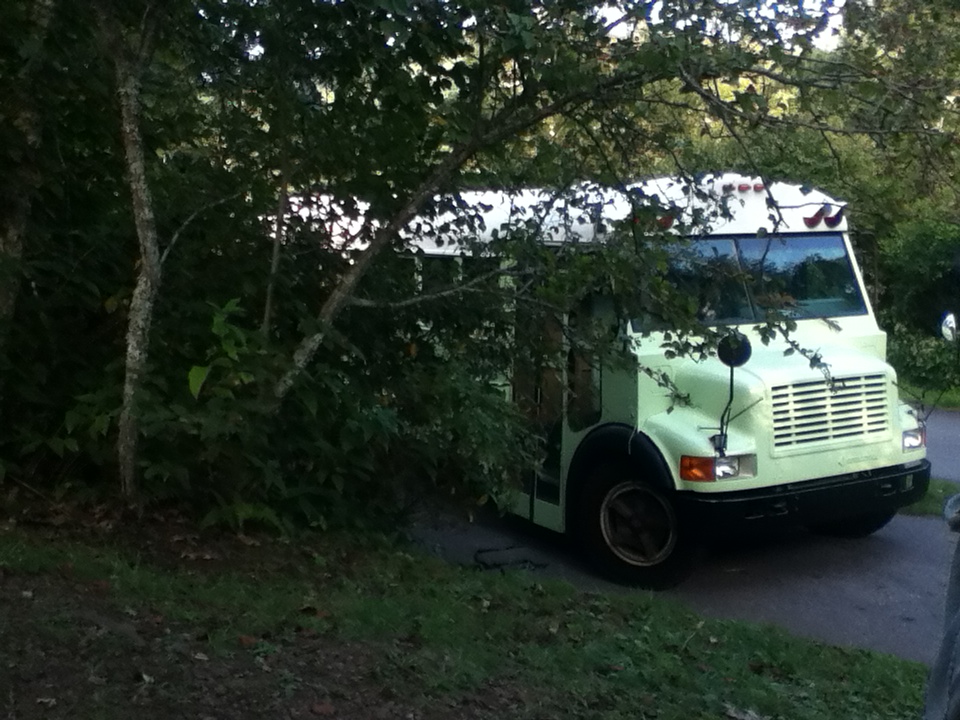
Dan's sister is having her third child this week, so we came to help babysit her other 5- and 6-year-old girls. Her husband works nights and sacrifices much of his daytime sleeping schedule to help out, but when a new baby is expected it's always nice to have a couple extra hands on board. They live in a nice residential neighborhood, and so some of the neighbors don't appreciate a big "ugly" green scary monster parked by the house. I think we look rather well put together, but I can see how the mystery could worry some people. Concerned neighbors called the police a couple times, and each time a Sheriff came he told us that as long as we weren't blocking anyone's driveway we weren't doing anything illegal, even though we mentioned the animals. Among members of the school bus conversion community it's a well-known fact that people tend to discriminate on "Skoolies" more than regular RV's, but this is the first time we've really experienced it.
Our bus is designed to keep our pets healthy and happy. We have AC for the summer heat, and both electric and propane heat for cold weather. We have screens on the windows for ventilation as well as a roof vent. Everyone has water at all times and is fed daily. The goat has unlimited access to hay and also has three different kinds of pellet food. When there's a dog park around we visit and let the dogs and goat run around like crazy people. When we are in an area that the dogs may bark at people walking by, we put up Reflectix in the windows so that they can't see outside and it keeps them quiet. If neighbors would take the time to get to know us, they would see that we're not scary, rude, abusive, or loud.
Yesterday I took everything out of the rear end of the bus so that I could clean the goat pen and storage areas. Rosie's pen is a 25 sq. ft. elevated grated floor with a front and back gate and a drop pan that drains into a closed bucket underneath. I usually clean it out every two weeks, which involves dumping the bucket and scooping out a couple 5-gallon buckets full of goat berries. The original idea was that both kinds of waste would go down the drain to a tank outside the bus, but with our time crunch to get to North Dakota we didn't manage that sophisticated of a system.
Cleaning the goat pen was the first step to a deep spring cleaning of the bus. When we lived in the pop-up camper, things got stinky even without the goat being inside very often. In the bus there's also a toilet. I don't know if you've ever been in an RV with a waste tank, but those gases tend to escape into the living area, and despite the chemical enzyme magic tablets that tout "odor-free!" there's not anything we can do about it until we have the time and money and tools to install an effective roof-vent.
Dan's mother is flying in to help out with the newborn baby, and she is a very clean person and has not yet seen the bus in person. So I wanted to make our bus as clean and nice-smelling as it can be. Unfortunately as I was scooping out goat poop a reporter came by and wanted to ask about the bus. Normally I would be thrilled, but I was appalled that she caught me with all my junk in the yard and covered in stink to boot. Hoping that she'd at least avoid broadcasting the mess, I brought out Rosie for her to see and told her our story. I told her that another day once the bus was clean enough I'd be happy to show her around. She had to leave for the five o'clock news, and as she drove away a man in a white SUV pulled up and began taking pictures of the goat and the bus without my permission. When I read "Code Enforcement" on the side of his vehicle I felt like I had been tricked into bringing the goat out onto the property.
I explained to him the two Sheriffs had already given us the "ok," but he said that they were wrong and he outranked them. That I'm not sure about, but whatever. He said that we were in a residentially zoned neighborhood and livestock were not allowed. He said that the local news station and some other neighbors had reported it. He was quite rude about it at first and kept ignoring me and taking pictures and talking on his phone while I was trying to converse with him. Dan came out and also explained that we were there to help his sister, and his sister's husband also came out and tried to explain. It wasn't until the 9-months pregnant lady came out of the house and her crying and confused six year old came to the door to watch that he seemed to believe what we were telling him. We're here until she comes home from the hospital to help out. The goat is not living here, and she's not even on anyone's property besides in her pen in the bus which was specifically designed for her. After that he softened a bit and said that as long as we could move the bus into the driveway and would leave before he came back in a week or two to check, then he would just send a warning to the house and that would be the end of it. We all thanked him for being so understanding, and were glad that we could continue to help the family.
Immediately afterward, as I was trying to reassemble the storage situation in the back of the bus, I got a phone call from the news station. The woman cheerfully asked me what the code enforcement officer had said, and whether or not we had been kicked out. I told her that he had mentioned that it was the news station who had tipped him off, and that we were not kicked out, and left it at that. She said it wasn't them. I didn't want to cause any drama or fuss with the news, because I don't want our lovely little band to be presented in a negative light. Today when Dan searched for "Gainesville FL goat school bus" an article popped up about the situation. I was satisfied with the way we were presented, but wished that they had left the address out for the privacy of Dan's relatives. I'm hoping to contact them about it today and ask them to please remove it. We're happy to answer any questions about our unique living situation, and provide tours and pictures, but not on the private property of a young family.
Here's the link to the news article:
http://www.wuft.org/news/2016/01/07/one-nation-under-goat-bus-swings-through-gainesville/
After all of this I went across the street to introduce myself to one of the neighbors who we suspected might be behind some of our problems. I shook his hand and had a pleasant conversation and explained why we were there and that we didn't want to cause any trouble for the community. He said that his grandkids had shown him our blog and that he thought what we were doing was interesting and thanked me very much for coming and talking to him. I wish I could talk to every naysayer in the community and show them that we're good people and that we're only here to help out for a short time. I believe that being open and honest with people who may be under- or mis-informed is the best way to fix this sort of thing.
So yesterday I was unable to clean the bus and I'm going to try and do it all today before Dan's mom arrives at the airport tomorrow. I hope she understands if it's not spotless.
This new computer has no pictures on it yet, but once things calm down a bit I'll try to fill you readers in on our journey across I-10. Hope you had a wonderful holiday!
Thursday, January 7, 2016

Sunday, November 29, 2015
Byre Lake and the Rockies
After the harvest was over we scooted quickly south to
warmer weather.

I live in my car. Why would I ever take off my pajamas?

Dan noticed this picture was in the camera right after the
previous driving shot. I can see the resemblance.
Somewhere in South Dakota there was a roadside attraction
that advertised a cowboy ghost town and buffalo herd. I wanted to check it out.
The place was pretty busy because it was the only gas station for miles, but
apparently no one ever went inside the cowboy town. The gift shop was also a
fireworks store and an overpriced grocery store for shelf goods and meats. All
of the souvenirs were left over from years ago, faded, and covered in dust.
Around the walls there were animatronics exhibits behind plexiglass walls of
cowboys and the piano-playing gorilla that would move and talk and play and
shoot if you put a dollar in. We didn’t want to see what they looked like in
motion. Apparently it was a preview for the cowboy town attraction, which cost
an extra $7 per person. The owner of the shop was sitting behind a paper-strewn
dusty check out counter behind racks of old souvenirs. I collect spoons from
places that I travel and I asked him if he had any from Nebraska, and North
Dakota, but he said he was out of those. But then he said that he had every
collectable shot glass, bell, thimble, magnet, and patch. He also sold buffalo
products, from teeth to jaw bones to tanned hides to meat and even green hides.
He also had many informational booklets about South Dakota and Badlands
National Park, and spent half an hour showing me all of the pictures when I
mentioned I had thought about visiting it. Dan stuck up a wonderful
conversation about New York and Las Vegas with the guy while I picked out a
buffalo tooth, a few magnets, a South Dakota spoon, and some bison jerky. I
wish I had gotten a green hide to tan because they were a steal at $80, but I
had nowhere to keep it and work on it. He was selling the tanned hides for
$700-$1500.

We left this little attraction and continued on South bound.
Right before dark we began to pass signs for the World’s Only Corn Palace, and decided to stop
to see it. It took a while to find, and by the time we got there it was dark,
so we just took pictures as we drove by. It wasn’t as interesting as it sounds
from the outside, but maybe it’s better inside. I didn’t realize that it was
actually open at the time we drove by, otherwise we would have parked and went
inside.

It was just a square warehouse building with cool looking
metal work and a few corn stalks glued to the front of it.
I asked Dan to find us an awesome campsite. Usually I’m the
one who does the logistics, but this time I let Dan handle it. He didn’t
disappoint. Our destination was Byre Lake in Kennebec South Dakota. It was dark
when we arrived and we still managed to easily find the dirt roads leading to
the lake, which had plenty of parking space, a picnic shelter with electricity
and trash cans, a pit toilet, and a boat ramp. It was rainy and cold and dark
when we arrived, so it wasn’t until morning that the beauty of the area was
apparent.

Along the road to Byre Lake.

The dirt road by the lake.

The dogs enjoyed running along the beach.
Apparently the place is popular with hunters, and there were
plenty of hunting parties and target shooting practices while we were there.
During the first dreary rainy day we were almost always alone, though, and
Rosie got to graze and the dogs had free space to run for acres on grass,
through fields, along roads and beaches, and in the woods. The next day we
moved close to the picnic shelter and hogged some power for a couple hours to
run the heater, do some cooking, and watch a movie while it was cold and wet
outside. The next day was sunny and warm, so I took the dogs on a hike and let
the goat out to graze. Walking along the beach I found a huge dead beaver,
halfway decayed at the edge of the water. I collected it teeth to add to the
buffalo tooth. Collecting bones is a hobby of mine, and I have a nice skull and
tooth collection. There was a swingset, volleyball net, and horseshoe game on a
grassy peninsula projecting into the lake, and I spent a while swinging and
taking pictures. The lake was calm and glassy. In the afternoon hunters came
with their dogs and a man went out on a tiny boat to fish, so we took the
animals back inside. Byre Lake was a welcome change from driving and sleeping
in truck stop or rest area parking lots as we do so often.

Plenty of room to roam.
Speaking of rest areas and truck stops; when you have a self-contained RV it's easy to stay overnight in almost any parking lot. We utilize this often, and when we're not in the middle of nowhere on free dispersed camping land, we often stay in casino parking lots, Walmart parking lots, rest areas, gas stations, truck stops, or roadside pull offs.

At one rest area we saw a familiar sight across the road: a sugar beet piler in operation!

Halfway over the Rockies we found a nice rest stop for the night.
We finally reached the Rockies and it was time to really test out our engine. She did wonderfully going up the mountains, albeit at a very slow pace. Down the Rockies was a bit scarier, though.

A first look at snow-covered peaks in mid-October.

An overlook offered a beautiful view of a mountain lake.

A lone cloud floated above the mountains.
On the way down we got a kick out of the warning signs for truckers. They were definitely heeded by us as well.


Even when staying at rest areas and truck stops we see wonderful views of the surrounding area.

This Love's truck stop was in the middle of lots of canyon walls.

This rest area had a wonderful sunset over the hills.
Between Byre Lake in Kennebec, SD and Moab, Utah, we stayed exclusively in parking lots. Moab was sure to have the warm dry climate we desired, and it was our main goal to get there as quickly as possible. Colorado is pretty, but too cold for me in October! We'll leave the Northern adventures for springtime. Next up... Moab Revisited!

BeetJuice! BeetJuice! BeetJuice!
For the bus’ virgin voyage after the in-chassis overhaul we
went to see my friend Justin in Asheville for Labor Day weekend. Finding a
campsite on that particular weekend is usually nearly impossible, and we
thought we were going to end up camping in Justin’s apartment parking lot. After
being turned down at Lake Powhatan, we decided to try our luck half an hour up
the parkway at Mount Pisgah campground, where we started our big trip last
year. If you remember, Justin got lost last time and didn’t make it, so this
time we came full circle! The tanks and toilet and back room weren’t assembled
yet, but it was still a comfy adventure. There was gathering of wood and
cooking of food on the fire, and plenty of beer and wine amounted to a festive
weekend. The doggies were very happy to see Justin because he’s their
dogfather.

Justin enjoying a beer at the picnic table. No flaming goats
this time.
Our first real camping experience in the bus!
After a fun-filled weekend we returned home and struggled to beat the
clock as it sped ever closer to the drive to North Dakota. Up to the last
minute we were packing, installing black and grey water tanks, backup cameras,
the back deck, and tail light wiring, and building a goat pen for Rosie and
George the rabbit. The drive from Statesville, NC to Drayton, ND is over 1500
miles and takes 25 hours of driving time going regular highway speeds in a car.
The bus tops out at 59 and averages about 50. Dan and I drove for 48 hours
straight, only stopping for food, gas, and two two-hour naps. We were also learning
to drive a 35-foot long 27,000 lb. bus that has loose steering. When we finally
got there and slept for the night it still felt like we were shake, rattle and
rolling along the interstate.

Intense concentration.
Drayton is a small town of about 500 people. Lots of people
live there for only a few months out of the year to work the beet harvest.
Along with the nice pay we were also given a free campsite to stay in with
water, sewer, and electricity and a bath house with hot showers and wifi. There
was a large field by the bath house that the dogs and goat enjoyed romping
around when we had some free time.

Juno's a lunatic.

Dan likes this picture because he's hiding his face.

American Crystal Sugars beet processing plant.
Our job was to receive beets by the truckload on a giant
machine that put them in piles 30 feet high. We worked night shift, 12 hours a
night, seven days a week, for two weeks. A couple of days we had off because of
bad weather. The reason so many people do the job is because of the pay. You
can expect to make over $1000 a week. When paired with a free place to camp,
it’s a great deal. It is very hard work, however, and most of the 300 temp
employees quit before the first week had finished.

At the end of a long cold night you can see the piler still
in operation.
Truckloads of beets came in 24/7 because the day shift
worked the opposite 12 hours. The trucks would enter the machine two at a time,
empty their beets into an end dump on either side of the machine, and then pull
forward under the dirt conveyor to retrieve the dirt that was sifted back out
of the beets in the machine.

This is a beet pile. It’s about 30 feet high, 100 feet wide,
and ½ mile long.
Dan worked on the ground at the foot of the pile. His job
was to direct trucks into and out of the machine, keep the ground free of mud
and beet chunk that fell out of the machine, and shovel any major beet spills.
He also had to retrieve sample tickets from the trucks and bag beet samples to
be shipped off to quality control for lab testing. The farmers are paid by the
weight and sugar content of the beets. I started out at this job and only
lasted a few days before requesting to be trained as a machine operator to
escape the freezing weather.
As a machine operator I controlled the conveyor belts and
hoppers of the piler machine. I was responsible for ensuring the safety of the
4-6 ground workers as they worked around moving parts. I simultaneously
controlled the directional light box (tells the trucks when to dump), the end
dump doors, the side and main conveyors, and the return dirt conveyors, and
moved the machine backward when it was time to extend the pile. Another ground
worker controlled the swing of the boom conveyor and the distance of the arm
from the pile to create a nice even crescent-shaped pile. This is important
because piling the beets in this way is how the beets are stored to prevent
freezing and thawing and damage or rotting of the beets inside the pile. Hard hats, safety glasses, reflective
vests, work gloves, and warm winter clothing with multiple layers were
essential.

In addition to all these button controls I had a set of
eight levers to push and pull.

This is the view from the operator cabin. You can see the
main conveyor with the boom swung to the left at the top.

Nap time!
After the initial rush of the first few days we had lots of
down time for naps. I sat in the floor of the cabin with my space heater and
woke up when I heard a truck pull up. There were nights near the end of the
harvest where we would only have one truck every half hour all night. The
lovely ladies at the scalehouse often made desserts and crock pot dinners for
the employees to help keep us warm and full. The operation has eight pilers working to store over 11 million tons of beets for sugar processing. Some days we would pile over 8000 truckloads of beets in 24 hours. It takes 10 lbs. of beets to make 1 lb. of white sugar. Each beet can be as small as a potato or as large as a human head! In fact, most of the beets weighed at least a few pounds.

One night we had to shut down and clean the machine. Dan
took this picture when he had to put on a safety harness and climb up onto the boom to clean out the
hopper.

Sunset from our campsite. This view meant it was time to go
to work. Every day at 7:40pm we caught a ride with our neighbors to work. A few
times we had to walk the mile to the factory.


Cottonwood trees lined the field beside the campground.
With $4000 in our wallet we quickly moved on to warmer Southern pastures when the hard work was finished.
Wednesday, September 23, 2015
Say Hi To Our New Ride!

I had hoped to finish writing about our trip by now, but things have been hectic. The last post was about Panoche Hill, CA. I've yet to tell the story of our time in LA, Yosemite, and Vegas. This all happened last November, and then we took I-40 from end to end in four days so that I could return home for my second knee surgery. We spent Thanksgiving day stopping at every casino on I-40 to earn ten bucks at a time, which was a fun way to spend the holiday. Two days before Christmas I had my knee surgery, and shortly after that Dan and I went to work on my friend's free-range hog farm. In February I took Dan back to New York so that he could make better money at his old restaurant job, and I continued working on the farm. A month and a half later I couldn't stand being still any more. I needed to travel, and the pop-up was just too tiny and took too much work for all we needed it to be. So we decided to save more money and get a larger something!
I took the animals and went back to my home in Statesville with my parents. There's a friend in Statesville who needed help building a wooden kayak for his wife's anniversary present, so I made some cash by the hour for the hundred hours or more it took to build the boat. I also sell items on eBay to save money and fund adventures. Dan and I shopped around, trying to decide what kind of RV to get. Definitely not a travel trailer, because then I'd have to have another larger tow vehicle to pull it. Big, old Rv's can be had cheaply, but the older they are the more likely they are to have water damage, and if the engine is gasoline it might be pretty worn out from lugging a giant thing around. We came across a Toyota Dolphin, which I had been interested in previously during my search for the pop-up. It's a small (about 15 feet) RV mounted on a small Toyota truck chassis. Gets 20+ mpg. They tend to have axle problems because the weight of the RV is too much for the factory chassis, but after a certain year they fixed that problem. I went to test drive one. It was very squeaky, flimsy, and top heavy. It was also too small.
Another idea I had been toying with was converting a school bus into an RV. The idea kept gnawing at me. A bus would be massive and unwieldy, yes, but sturdy and customize-able. Plus it would have plenty of space and a good diesel engine. Dan and I were each going to split the cost of whatever we decided on, and were willing to spend about $8000 on an RV. After test driving that Dolphin I decided for sure that I wanted to go the school bus route.
I shopped around on Craigslist for a while, but buses on there are worn out and overpriced, so I decided to go straight to the source for used buses. When a school bus reaches so many years or miles, the school system buys a new one and sells the old one to the public. It's a good way for the school to raise money. Some of them are bought by churches, or scout groups. Most of them are bought by people from Mexico who come once a year to purchase every available bus they can find to use as paid public transportation units in Mexico. North Carolina is a great place to buy a bus because it won't have much rust like Northern buses. I found a website that listed all the available buses for sale from every school district in NC, and I visited four garages around the state to find the bus I wanted. In Alamance county I bought a 1993 International Navistar DT360. It's full size at 32 feet long with ten windows, has an inline six cylinder turbo boosted engine, great tires (which are important at $300 a pop), and full 60 gallon tank of diesel. $3000 and my dad and I drove it home that day. Don't tell the police about that part. We don't have CDL's.

On the drive home we noticed the steering box was super loose and had a couple inches of play. I started reading the three-page long file of previous records that I kept asking for and was finally given at the last second, and saw that the oil analysis showed coolant in the oil. My heart dropped. That is NOT a good problem to have. It's a potentially expensive one. When we got it home we saw milky oil on the dipstick. Another sign of coolant in the oil. But we drained the oil pan and saw no water in it, and did a pressure test which told us there was no leak. We thought maybe the milky oil was just vapor condensation on the stick which can happen if you start the bus without getting up to temp. So we said "whew, close call!" and went on with the conversion.

I worked on it slowly for a couple months while working on the kayak for cash. My friends helped pull the seats out and paint the inside. I put down maple laminate flooring for the living room and bedroom, and black and white checkers for the bathroom and kitchen.

We planned to convert the bus to run on veggie oil, so I bought tanks and all the large items for the rest of the build. I picked Dan up from Long Island in June and we began building the interior together. We put up three walls with windows and doors in them, installed a window AC, put in a clawfoot bathtub, and large cast iron kitchen sink, made a couch and memory foam bunks, all while living in the bus with the cats because they're not allowed in my parents' house.


We got the bus inspected by the DMV and had our title changed to "House Car," which is NC's designation for converted RV's. Then we hit a big speed bump. Couldn't find insurance. No company likes to insure these things because they say they're top heavy and dangerous. They're not top heavy, but I could understand how a DIY project could be a risk if not done properly. Even National General, a company that actually DOES insure Skoolies (the name for a bus conversion), said the only state they won't insure in is NC.
South Dakota allows non-residents to register vehicles there. Lots of full-time RV-ers register there because there's no income tax and you don't even have to ever go there to be considered a resident. You have to step foot there for one day to receive a driver's license, but it's not necessary to get a license there if you don't want to. We decided to register the bus in SD so we could use National General, but we had to wait three weeks for the title to come back. It finally came in the mail, and I decided one last time to try and find insurance in NC first. SD may not have income tax, but it does charge registration fees by weight. They love RV's because each RV-er will pay over $300 a year in registration fees. Then the insurance on top of that. I talked to Farm Bureau here in Statesville and to my surprise they were able to get us liability coverage. $222 a year, and we were legal to drive! We went two miles down my road to get an inspection. $13 for a safety inspection since old diesels don't require emissions testing. Woo! On our way back home, alarms began to sound and the oil-coolant light flashed. Uh-Oh.
I pulled in the driveway and stopped. Checked the coolant. There was none. Checked the oil. Chocolate milk. Houston, we have a problem. A big problem. It seems that there was a leak after all, which turned into a big big leak after sitting for a couple months.
We drove the bus to the garage and started taking the engine apart to diagnose it. Four possibilities: broken oil cooler, leaky cylinder O-rings, busted head gasket, or corroded cylinder sleeves. Not the oil cooler, since there was no oil in the coolant, only coolant in the oil. We completely pulled the head off the engine and there was no problem with the head gasket. Then we pulled the sleeves. There were no holes in the sleeves but there was minor erosion. The O-rings were hard-baked from a frequently overheated engine, and lots of them were completely cracked. Found the problem. O-rings are cheap, luckily. So we needed to replace those and put on a new gasket set, which has to be done anyway any time you remove a gasket. That's about $200 worth of parts. Good. Not $1200 for a whole rebuild kit. Two of the cylinder sleeves had more corrosion than the rest, so my dad wanted to get us replacements for those at $125 a piece. I searched for parts online and saw a list of parts with no prices from a company in Nevada. I called them and they told me they were a distributor and didn't generally deal with the public but that they would make an exception for me. Here's the reason auto parts stores stay in business; the same parts that would have cost me $450 at a retailer online cost less than $100 from the wholesaler. An older engine can also have worn out bearings, so for those kind of prices we added extra parts to our order such as oil control rings, a third replacement cylinder sleeve, main bearings, and rod bearings. Our total order was about $350. The same order would have cost $1000 or more from a retailer.

A week later our parts and in an we spent a few days rebuilding the engine. One of the last steps is to torque the bolts to specifications. The book said 130 ft. lbs. on the connecting rod bolts, which seemed a bit ridiculous, but OK. Started to tighten them and they stretched, so we stopped after the first one. Looked it up online and the manual was wrong. It was supposed to be 80 ft. lbs.! Yikes. I called about fifty diesel shops and the International dealership trying to find two connecting rod bolts, but the ones for this engine were discontinued. My dad found some that his mechanic friend could order and get shipped within three days. $75 for two bolts and nuts. Ew. But we had to do it. When we finally got it back together and turned the key, it started right up! My dad has worked on cars his whole life, but never a diesel engine. We bought the maintenance manual and followed the instructions, and Dan and I did most of the work. He's even less experienced with cars than I am, but it wasn't hard. We took the unfinished bus on its maiden voyage to Asheville on Labor day weekend to visit my friend and camp on the Blue Ridge Parkway. It was also a nice break-in period for the engine to seat the new O-rings, and gave me plenty for driving practice with curves, steep grades, and stop lights. Dan got the practice driving on the interstate.
After the weekend we kept working on the bus. There's a beet harvest in North Dakota and Montana every year that pays $1200 a week for a month. They mostly hire RV-ers, and pay for a campsite and electricity if you work there. We applied and were told to be in Drayton, North Dakota on September 25. For the last two weeks we've been working non-stop to finish so we can get on the road. We put in two backup cameras, added grey and black water tanks, plumbed the toilet, sink, and tub, my dad built a three-foot back deck complete with tail lights and turn signals to haul the generator, bikes, and hay bale, and he specially engineered a passenger seat for the front that folds up out of the way. We really could not have done this project without him and I am so grateful for his help. He's put so much time and work into this because he wants me to be safe and comfortable and accomplish my goals. I think he also thinks it's pretty awesome to tinker on a school bus.
Yesterday we built the goat pen in the back next to the chest freezer-turned refrigerator and mini-washer-dryer combo unit. Rosie will have her own 25 sq ft bedroom with a rinseable drained grate floor. It's on a 2-foot high platform with storage space uinderneath. She'll love riding high up in the air and not getting yelled at for pooping in the car. She has plenty of windows to look out, too!
We're all tired and sore from working so hard and long, and today is finally the day we leave. The goal was that yesterday would be our latest possible day, but the work just wasn't done. I still have to lug all the crap I packed into the bus and pick up the goat, and then we're outta here! 1500 miles from here to Drayton, and two and a half days to get there. We're hoping two twelve hour days for driving will get us there in time to sleep before meeting the beet boss at 10 am on Saturday.
My laptop screen died, and we won't have internet or time anyway, so I won't be able to add pictures to this post until later. I'm typing on my dad's laptop at the moment. If you'd like to see pictures and a detailed account of the bus conversion, take a look at the forum thread I've started on Skoolie.net. You can easily access it by typing in tinyurl.com/onenationundergoatbus or clicking on the link. Adios, folks, and wish us luck!
Subscribe to:
Posts (Atom)